My mom got pregnant fifteen months before the Pill came out. That was lucky for me, at least. For her, I’m not so sure; she’d already had three kids in 1946 (brother Mike), 1949 (sister Pam, and 1951 (sister Jan), and I’m sure she figured she was done with such things.
The author emerges, December 5, 1959, in a room at Emanuel Hospital in Portland, Oregon, and our story begins. 9 1/2 pounds!
I guess my dad was also partially responsible. But his was only a recurring cameo role in my childhood movie. Dad was a long-haul truck driver, home twice a week, and he liked things that way. The normal domestic family life was not his gig. (I’m not engages in mind-reading here. It was something he told me in my thirties, when we were exchanging memories. And I get it, being an ambivert myself. He just took it to extremes.)
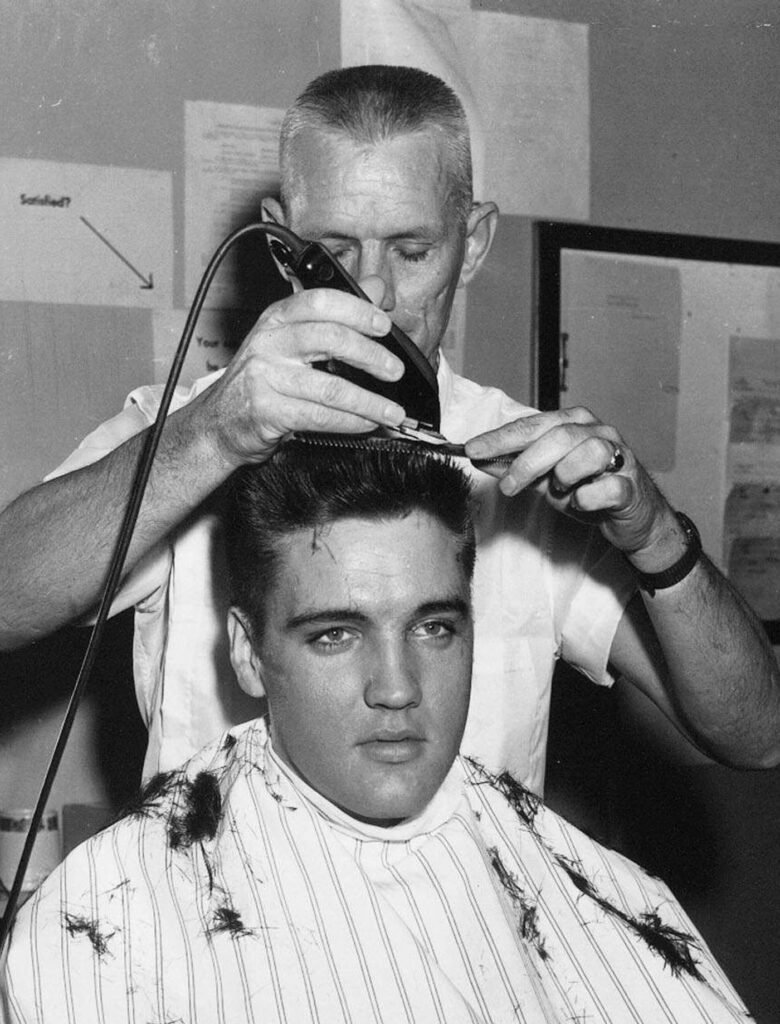
Anyway, in childhood, my dad only had sustained direct interaction with me when I was 5-6 years old. He must have liked kids that age; he taught me to read in the summer of 1966 and then sometimes took me out of first grade on Fridays to have lunch with him at the local Village Drug food counter. (Dad did also take me to the barber for a buzzcut –see Elvis pic above– but I eventually put my foot down about proper hair length.)
By the numbers:
- 31% of the U.S.’s 151 million residents were under age 18. (By the end of the Baby Boom, around 77 million babies will have been born.)
- More than half of all people (68% of men and 66% of women) were married.
Only 3-4% of Americans in 1960 had a Bachelors degree, compared to nearly 40% today. - 35% of the private workforce was unionized by the mid-1950’s, securing high wages and benefits.
- Less than a quarter of married working-age women had jobs. (The five most popular jobs for women of this era were secretary [stenographer or typist], salesperson [retail], schoolteacher, bookkeeper, and apparel factory worker).
- City suburbs grew 47 percent in the 1950’s; home ownership increased 55% overall.
- In 1950, 9% of households had a TV. By the end of the decade, almost everyone did.
- The 1950’s economy in the United States was a post-WWII “golden age,” characterized by a 37% surge in GDP growth, low unemployment, and booming consumerism, with inflation averaging only 2% a year. Strong union jobs, suburban growth, and high manufacturing output created a prosperous middle class [assuming you were White!] with significantly higher purchasing power than in years previous.
- Source: HistoryFacts
My family had moved from Eugene to Lake Oswego, Oregon, a town just south of Portland, in 1958. (I won’t regale you with my family members’ memories of living on Bushnell Lane in Eugene, because I never really heard any. It’s weird, because I was a pretty savvy eavesdropper as a kid.) Now, concerning Oswego: as I type, in 2026, L.O. has grown a bit. But back then, it held maybe 3000 Oregonians, gathered around a man-made lake amongst the Douglas Fir.
For those of you who, like me, love maps (Atlases! Globes! Maps you bought at gas stations!), here’s a view of Oswego from roughly that time:
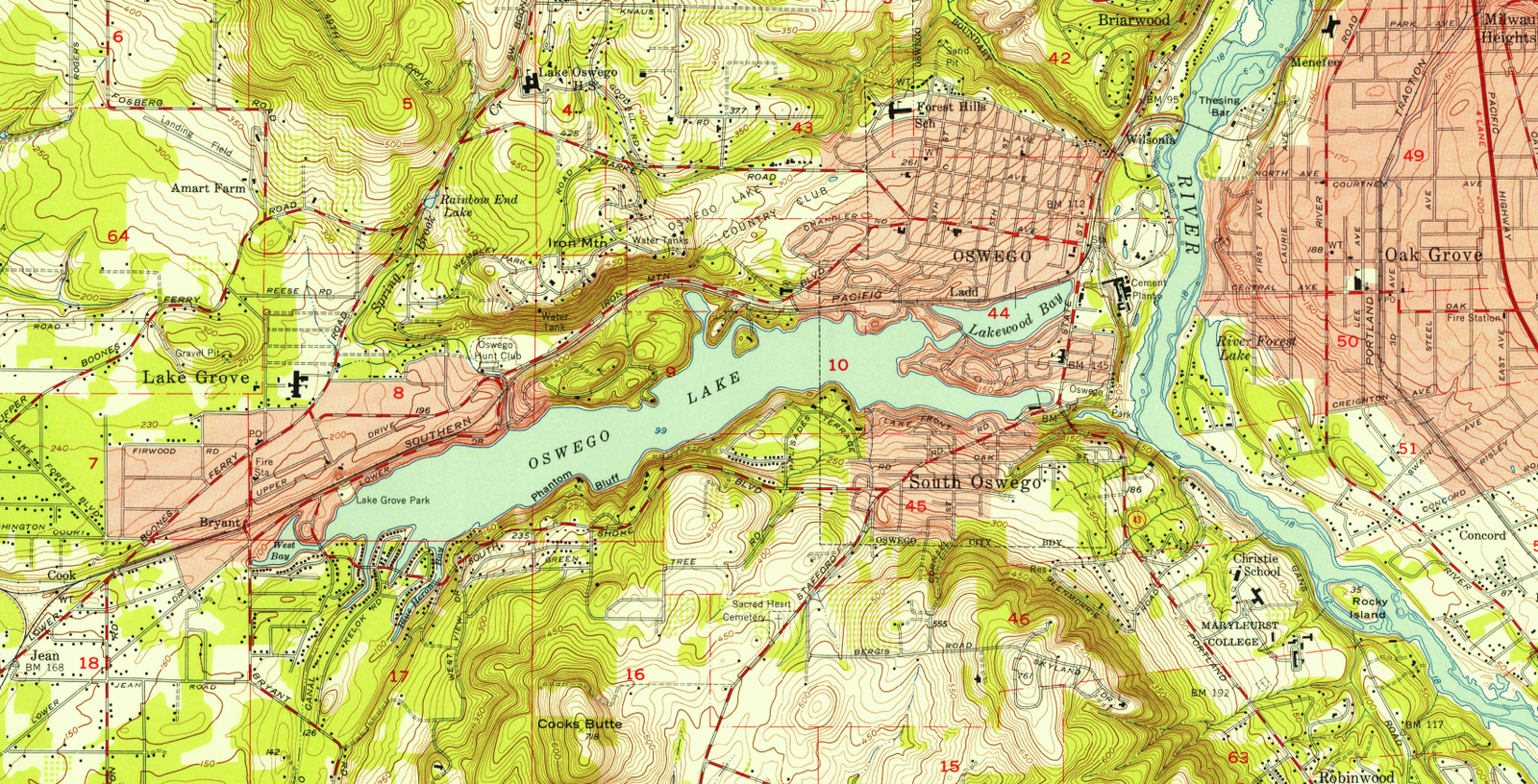
(Pink is built-up area. The dots outside are buildings, standing alone on the prairie.)
Now, the idea of my effort is to regale you with this my life, and to link my memories with cultural touchstones that might ring true to you as well, so that you can hum along. With this in mind, let me lay on you a few tracks to start with that seem like they might provide the appropriate vibe for a fetus entering into the sunset of the Eisenhower years. (Man, wasn’t that something, when we had moral and competent Presidents?)
Here are a few songs (five,actually) to start with from that time. They paint a picture in my head of when boys wore coonskin caps, their older brothers rode motorcycles, and their older sisters spent evenings laying in the hall, hogging the phone.
I spent my toddler-y years in Oswego, at 172 Middlecrest, until we moved in the spring of 1964, when I was four. (I later found the correlation of my age and the year to be convenient, perhaps even a vindication of my incipient egotism.) During those toddler-y years, I preferred to spend my hours in the living room. (I didn’t have a bedroom of my own. There were no bedrooms to spare. Perhaps, in retrospect, that might have dampened any incipient egotism.)
Two places in the living room had especial appeal, and one of those was in front of the eight-inch black and white TV. Now keep in mind that unless my mom dragged me off somewhere, I could enjoy my shows in peace, since my siblings were away at school. The other spot in the dining room was behind my dad’s big recliner. I could hide there and look at books from the bookshelf that was there.
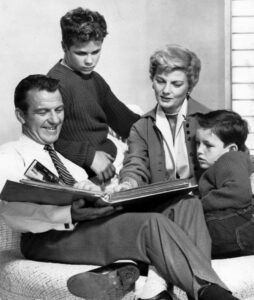
It was from the TV, though, that I became attuned to the culture bequeathed to us by the 1950’s: I Love Lucy, Father Knows Best, Perry Mason, the Honeymooners. And Davy Crockett: great theme song. By that point, Westerns were a major TV genre. Seriously. It was like every other show was a Western –at least until 8:30 pm, which was my religiously enforced bedtime.
That probably encouraged boys –not girls!– to play Cowboys and Indians in immersive sessions lasting all afternoon. I personally preferred, though, to play Army, fighting the Germans (the default opponent until at least the early Seventies, when the Russians took over that role).
Anyway, this is the gig I was posted to. I hope you mostly enjoy my journey. Maybe even tap your foot to the soundtrack, once in a while. 🙂